Metal Building Price Index 2026: Steel Costs And Trends
Metal building prices follow steel prices, but not one for one and not right away. This page tracks two official U.S. price series from the Bureau of Labor Statistics (BLS) every month since January 2019, shows how they've moved, and turns them into a simple cost per square foot index for a typical kit. You can download the full data as a CSV.
Key numbers, checked October 2026 (BLS data through September 2026):
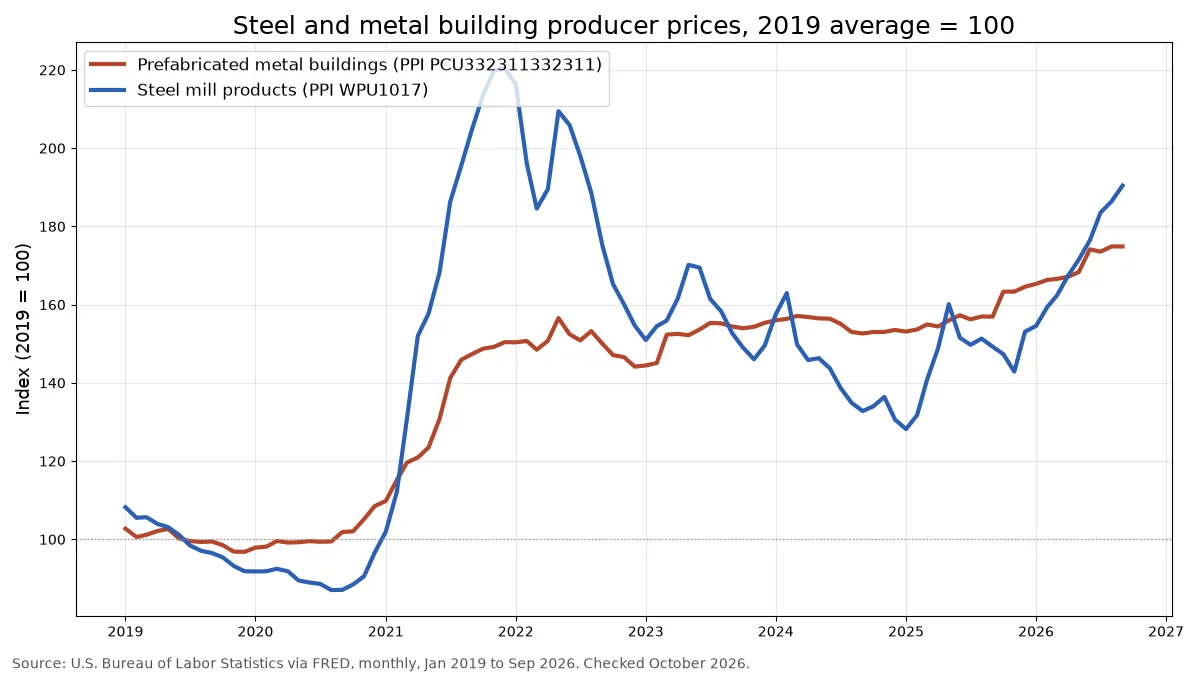
- The producer price index for prefabricated metal buildings was 581.3 in September 2026, up 11.4% from September 2025 and about 75% above its 2019 average.
- The index for steel mill products was 388.6 in September 2026, up 27.6% from a year earlier and about 90% above its 2019 average.
- Steel mill prices peaked in December 2021, at about 120% above the 2019 average. Metal building prices didn't fall back the way raw steel did, and hit a new high in August 2026.
Steel Price Trend
We track two BLS producer price indexes (PPI). A PPI measures the prices that U.S. producers get for their output, so it reflects what manufacturers charge, not retail quotes.
| Series | BLS ID | What it measures |
|---|---|---|
| Prefabricated metal building and component manufacturing | PCU332311332311 | Prices manufacturers get for metal buildings and parts |
| Steel mill products | WPU1017 | Prices for steel sheet, coil, plate, bars and shapes from mills |
Annual averages for each index:
| Year | Prefab metal buildings PPI | Steel mill products PPI |
|---|---|---|
| 2019 | 332.4 | 204.1 |
| 2020 | 335.2 | 184.5 |
| 2021 | 444.0 | 350.9 |
| 2022 | 499.0 | 381.5 |
| 2023 | 506.6 | 319.6 |
| 2024 | 515.1 | 291.4 |
| 2025 | 523.8 | 298.4 |
| 2026 (Jan to Sep) | 565.5 | 351.9 |
What the trend shows
Steel prices were fairly flat in 2019 and dipped in 2020. In 2021 they nearly doubled as demand came back and supply chains were disrupted. Steel mill prices then slid through 2023 and 2024. They rose again in 2025 and climbed sharply through 2026.
Metal building prices behaved differently. They jumped in 2021 and 2022 along with steel, then kept rising slowly even while raw steel prices fell. That's because a building price includes much more than steel: labor, engineering, energy, freight, paint and coatings, and overhead. Once those costs went up, they mostly stayed up. In 2026 the steel increase began to feed through again, and the building index set new highs.
Building Cost Index
To make the data easier to use, we built a simple cost per square foot index for a typical metal building kit with a span between 40 and 79 feet. We start from our current 2026 kit price range of $14 to $17 per square foot, from our metal building prices research, and scale it back by the annual change in the prefabricated metal buildings PPI.
| Year | Estimated kit price per sq ft (40 to 79 ft span) |
|---|---|
| 2019 | $8.20 to $10.00 |
| 2020 | $8.30 to $10.10 |
| 2021 | $11.00 to $13.30 |
| 2022 | $12.40 to $15.00 |
| 2023 | $12.50 to $15.20 |
| 2024 | $12.80 to $15.50 |
| 2025 | $13.00 to $15.70 |
| 2026 | $14.00 to $17.00 |
This is a modeled estimate, not a survey of quotes. Real prices vary with size, loads, options and supplier. Use it to see the direction and size of changes over time, not as a quote. For a price on your own building, use our cost calculator.
By Region
BLS doesn't publish these producer price indexes by region, so the national trend applies everywhere. Regional differences in what you pay come from other things:
- Design loads. Areas with heavy snow, high wind or seismic activity need more steel per square foot.
- Freight. Buildings ship from manufacturing plants, so distance adds cost.
- Labor. Erection and concrete costs follow local wages.
- Codes and permits. Some areas have stricter requirements and higher fees.
Our state guides, such as Colorado and Oklahoma, cover local factors. For larger commercial buildings, see warehouse building costs.
How Steel Prices Feed Into Building Prices
Steel is usually the biggest single material cost in a metal building kit, but it isn't the whole price. The frame, purlins, girts and panels are all steel. The rest of the kit price goes to design and engineering, fabrication labor, coatings, fasteners, trim, freight and the supplier's overhead and margin. That's why a big swing in raw steel prices usually moves building prices by a smaller percentage.
There is also a delay. Manufacturers buy steel ahead of time and quote prices that are held for a limited period. A change at the mill can take a few months to show up in building quotes. When steel prices are rising fast, suppliers shorten how long quotes are valid, or add surcharges.
What this means for buyers:
- When steel is rising, locking in a price with a deposit can save money.
- When steel is falling, building prices may lag, so it can pay to compare quotes and ask for updated pricing.
- Ask how long a quote is valid and whether it can change before delivery.
Tariffs And Trade
Tariffs on imported steel affect prices across the U.S. market, since domestic mills price against imports. Changes in tariff policy have been one of the drivers of steel price swings in recent years, including in 2025 and 2026. We don't try to predict policy, but if you're planning a building, watch the monthly steel numbers and ask suppliers how they handle price changes.
Other Costs That Move With Steel
The kit is only part of a finished building. When you budget, remember that other parts of the project follow their own price trends:
- Concrete. Ready mix prices have their own cycle, driven by cement, aggregates, fuel and local demand. A slab can be a large share of the total for a small building. See our concrete slab calculator.
- Erection labor. Crew rates depend on local wages and how busy erectors are in your area.
- Insulation, doors and windows. These are priced separately and can change with their own material costs.
- Freight. Diesel prices and distance from the plant affect delivery charges.
So even if steel prices level off, the total cost of a finished building can keep rising, and the opposite can also happen.
Reading A PPI Number
A PPI value on its own doesn't mean dollars. It's an index compared with a base period that BLS set years ago. What matters is the change between two dates. To find the percentage change, divide the newer value by the older one and subtract 1. For example, 581.3 divided by 521.7 is about 1.114, so prices rose about 11.4%.
Charts And CSV
The full monthly data is free to download:
- Download the CSV (monthly, January 2019 to September 2026)
Columns: month, the prefabricated metal buildings PPI (PCU332311332311) and the steel mill products PPI (WPU1017). Both are in the original BLS index points, not rebased. You're welcome to use the data with a link back to this page.
Methodology
- Data source: BLS Producer Price Index series PCU332311332311 and WPU1017, downloaded through the Federal Reserve Bank of St. Louis FRED service. Checked October 2026.
- Frequency: monthly, not seasonally adjusted.
- Annual averages: simple average of the monthly values in each calendar year. 2026 covers January to September.
- Chart: both indexes rebased so their 2019 average equals 100.
- Cost index: our 2026 kit price range of $14 to $17 per square foot, scaled by the ratio of each year's average building PPI to the 2026 average.
- Revisions: BLS revises recent PPI values, so the latest months may change. We'll update this page as new data comes out.
How To Use This Index
The index is most useful for three things:
- Checking an old quote. If you got a quote a year or two ago, compare the building PPI then and now to see how much prices have likely moved.
- Timing a purchase. Rising steel prices often show up in building quotes a few months later.
- Budgeting a future project. If you plan to build in a year or more, add a buffer based on recent price trends.
For example, a kit quoted at $50,000 in September 2025 would be about $55,700 at September 2026 prices if it followed the building PPI exactly ($50,000 x 581.3 / 521.7).
FAQ
Are metal building prices going up in 2026?
Yes. The BLS producer price index for prefabricated metal buildings was up 11.4% in September 2026 compared with a year earlier, and steel mill prices were up 27.6%.
How much does steel affect the cost of a metal building?
Steel is the largest material cost in a kit, but labor, engineering, coatings, freight and overhead also matter, so building prices usually move less than raw steel prices.
When were steel prices highest?
Steel mill product prices peaked in December 2021. Prefabricated metal building prices hit a new high in August 2026.
How often is this index updated?
BLS publishes new PPI data each month. We plan to update the chart, tables and CSV as new months come out, and we note the date we last checked the data.
Can I use this data?
Yes. Download the CSV and link back to this page as the source.
Sources
- U.S. Bureau of Labor Statistics PPI, prefabricated metal building and component manufacturing (PCU332311332311), via FRED, checked October 2026.
- U.S. Bureau of Labor Statistics PPI, steel mill products (WPU1017), via FRED, checked October 2026.
Ready to price your building? Get free metal building quotes from suppliers who serve your area, or use the form on this page and our team will be in touch.